It was my first mid-hike sighting of a “croo” member, the young people who run the Appalachian Mountain Club’s high mountain huts. My dad and I were on our way to the most remote of these backcountry hostels — Galehead Hut — where we would recover from our hike with heaping plates of lasagna prepared by the croo and served family style, before climbing into creaking bunk beds and letting the snores of other hikers lull us to sleep.
This wasn’t our first experience with the AMC huts. We had gone swimming near Lonesome Lake Hut and gawked at the namesake cascade at Zealand Falls Hut. But seeing that croo member hauling more than half her weight in perishables up to her seasonal homestead, through a thunderstorm no less, had an entrancing effect on me — as though I had briefly crossed paths with a forest spirit from a Hayao Miyazaki movie. She had seemed at home in the woods: dripping with rain, splattered with mud, and cruising along. The realization that one could love such a wild place — let alone live in these mountains — excited me.
And that’s kind of the purpose of the AMC huts: facilitating experiences and encounters that make it easy to fall in love with the White Mountains of New Hampshire and come back for more. Whether it’s the thrill of meeting the croo on the trail, watching a fuchsia sunset from the hut porch with a plate of homemade gingerbread cake, or making friends at the long communal dining table as a hailstorm batters the windows, visiting an AMC hut can be a gateway to a long career of hiking in the Whites and beyond.
In my case, the “career” part ended up being literal. From my freshman year of college in 2007 to my early days as a freelance writer, I baked anadama bread, folded bunk room blankets, and responded to search-and-rescue calls, during stints at six of the eight AMC huts. By the time I hung up my pack board and “retired” in 2014, I could tell hikers which trail offers the shadiest and coolest passage to the cone of Mount Adams on a broiling day, or what you should do when you pop around a corner and there’s a black bear sitting on the trail, staring at you.
Kristine Grimes, a realtor in Boston, started visiting the AMC huts with her two children in 2011, and the accessibility of the huts set the stage for them to become regular mountain explorers. “Having a roof, a bunk, and food made it possible to take my kids into the mountains as a single parent,” Grimes says. Pretty soon, their adventures escalated. “Once, on the suggestion of some hut guests, we hiked from Lonesome Lake Hut to the summit of Cannon Mountain,” Grimes recalls. They were up so high, they could see a helicopter circling below them. “My kids felt like superheroes.”
The high mountain huts are iconic parts of the outdoor experience of New England. In recent years, however, they’ve been buffeted by two unpredictable forces. The first was the surprise impact of the pandemic, leading to a precipitous decline in stays that’s still being felt. The second force is arriving more slowly: the changing tastes of travelers.
Outdoor recreation has grown wildly popular over the last decade, and demand for rural lodging has grown with it. In theory, this could be a boon for the AMC. But America’s outdoor hospitality industry has been moving in a cushier direction. In 2023, 58 percent of all campers in the United States opted at least once for ritzy “glampsites,” according to a report from Kampgrounds of America, a network of some 500 privately-owned campgrounds.

Reckoning with evolving tastes is an inevitability for any business or organization. But in a landscape where luxury yurts are beginning to outshine rustic backcountry dwellings, where does that leave the AMC huts? As a former croo member, I wanted to assure myself that they’re going to weather the storm.
In 1888, the AMC began managing bare-bones mountain shelters — little more than a damp floor, stone walls, and a wooden door — but the list of amenities grew as hikers embraced the dwellings, starting with a wood stove here, then a few cots there. Then, in the 1930s, the AMC reimagined the huts as cozier lodging destinations.

It was during this evolutionary era when family-style meals, bunk rooms with mattresses and blankets, and live-in staff members became pillars of the huts experience. In 1961, US Supreme Court Justice William O. Douglas published a National Geographic article on his visits — “The Friendly Huts of the White Mountains” — and interest boomed.
Today, most of the huts close during the colder months, but a few of the lower elevation ones revert back to “self-service” mode, in which you have to bring your own food and bedding. But the “full-service” season — stretching from May to October — is the most popular window for spending a night in a hut, as well as an important time for the AMC to raise revenue to support facilities, trail maintenance, and educational programs.
This is why I was somewhat spooked last summer when Globe columnist Larry Edelman spoke with AMC president and CEO Nicole Zussman about why the club had downsized its workforce. The 7.5 percent cut was intended to help close a $2.5 million deficit in its $35 million operating budget, Zussman said. She cited a decline in revenue from AMC facilities (which include the huts in the White Mountains, along with lodges and campgrounds throughout the Northeast).
Part of the occupancy dropoff was due to the COVID-19 pandemic, which understandably dampened the prospect of swapping exhalations inside a packed hut bunk room or dining area. But Zussman also noted that some of the AMC’s lodging facilities lacked the “features people are looking for these days” — features one can find at glamping sites that didn’t really exist a decade ago.

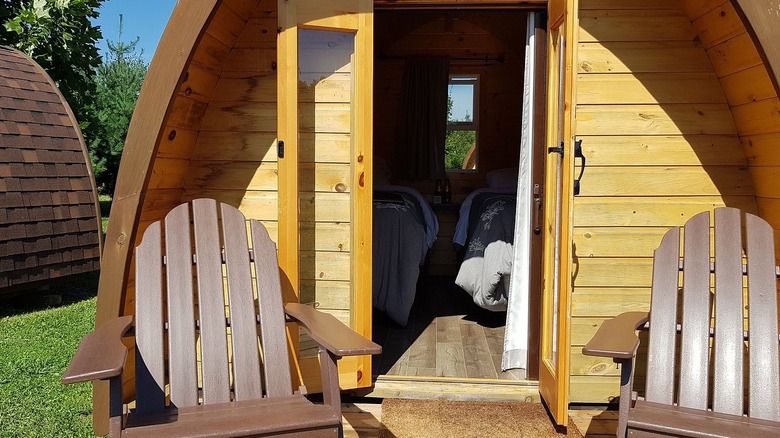
Today, the huts are competing with the likes of Alpine Garden Camping Village and Winery, a beautiful family-owned glampsite next to Crawford Notch State Park. Instead of sharing a rustic hut bunk room with more than a dozen fragrant hikers, imagine driving up to a brand-new cabin with plush memory-foam mattresses, a full kitchen, air conditioning, Wi-Fi, and a patio festooned with fairy lights, and you’ll have a picture of where a lot of backwoods-bound travelers are bunking up today.
The trend is something AMC is thinking about a lot these days. Bethany Taylor — the AMC huts manager, who’s based at Pinkham Notch Visitor Center but frequently out in the field — spends some of her time figuring out the balance between offering an enjoyable experience for hut guests and keeping the lights on.
Keeping the huts going is a minor miracle each season, one that comes with expenses. While the croo members bring in perishable foods to each hut on their backs, bulk supplies of canned goods and grains are flown in by helicopter at the start of each season, along with cylinders of natural gas for the kitchen stoves. (The electricity is generated from solar panels, which require maintenance.)

“Helicopter fuel is never cheap,” Taylor says. “But it’s also never just one thing that can push the operating budget or force changes.” In the early 2000s, when Taylor worked as croo, the huts had to look extra hard for powdered eggs because the US military had bought out much of the available supply and shipped it to Iraq. The huts aren’t immune to historic events such as a war, a pandemic, or wallet-straining inflation.
“The 2022 occupancy rates for the huts were way down, compared to pre-pandemic years,” Taylor says. In 2019, guests spent 45,838 nights at the huts, a point that has yet to be reached again. In 2022, the year the huts fully reopened after the pandemic, that number nose-dived by 25 percent.
But as Taylor sees it, that was a temporary dip. “I don’t think this decline in visitation was due to anything beyond COVID-19.” Taylor’s optimism is bolstered by the fact that hut occupancy has been slowly building back up. Last year, guests spent 39,931 nights at the huts. That’s still nearly 13 percent below the pre-pandemic number, but Taylor expects the steady climb back to continue this year.
She believes New Englanders’ travel could trend more local in the years ahead, which would help the huts fully rebound. “A lot of people were sitting on vacation savings during the pandemic and by 2022, they were like, ‘We’re going to Europe!’ or ‘I’ve always wanted to see the Grand Tetons,’” Taylor says. “There was this pent-up need to explore beyond one’s own backyard, and for a lot of the demographics we pull from, the huts are part of their backyard.”
The disruption caused by the pandemic coincides with another seismic event for the huts and the AMC in general — the aging of the baby boomers, and the imperative to cultivate the next generation of hut guests (and AMC donors). And this brings up something that can be awkward for the club: the cost of staying at a hut these days.
While midweek discounts are often available, a single, midsummer night in the huts for non-AMC members can cost up to $600 for a family of four. That’s in the ballpark of what it costs to spend two nights at a cabin for four at the Alpine Garden Camping Village. While the glamping site doesn’t include meals, which do come with a hut stay, the question some travelers will ask is, “Why would I pay to sleep in a bunk room for a night, when I could stay someplace more luxurious and private for two?” It’s a fair question. But comparing an AMC hut to a glampsite misses the point of what the AMC huts are, and what they’re meant to offer.

Consider Carter Notch Hut — the easternmost hut in the network, tucked in the wooded saddle between Carter Dome and Wildcat D mountain. It’s an eerie, mystical place in summer, with the howl of wind blowing through the notch. But in winter, when the hut operates in self-service mode, it becomes downright magical.
The trail up to the hut becomes a frozen corridor of snowbound pines. A live-in caretaker feeds logs into the hut woodstove and schleps buckets of water from a nearby pond, where a hole needs to be cut into the ice. On any winter weekend, Carter Notch Hut is a toasty sanctuary where you can find yourself sharing stories with fellow travelers, as steam from the pot of spaghetti they’re cooking wafts through the kitchen. The austere nature of a backcountry setting has a way of making these little things feel extra nourishing, and not so little at all.

The AMC huts are the opposite of backcountry Airbnbs and glamping sites that offer seemingly endless rosters of amenities. The huts offer immersion in a truly wild place, garnished with just enough edible and gregarious comforts to make it fun.
When I spoke with Zussman, the AMC president, about the efforts to attract new visitors, I asked her how the club aspires to find a balance between meeting contemporary travelers where they are — a growing appetite for the finer things included — and preserving the experience that the AMC huts can still provide to hikers of diverse ability levels. “The generation that I want to visit the huts are traveling places because an influencer on TikTok told them where to go,” Zussman concedes. “But at the same time, we don’t want people laying in their bunk beds looking at their phones. The breakthrough is reaching new audiences through digital media, and offering an amazing off-grid experience with like-minded people.”
Zussman cites the communal elements of the huts, such as “showing up at the end of the day and sharing experiences with each other” as the special sauce that will continue to attract visitors. As she sees it, the huts’ social side may become more alluring in the digital age, when many are feeling lonelier than ever.

“People are seeking community,” Zussman says, “and that’s something we have.” Sharing the White Mountains with fellow hikers, on the trail and at the huts, has a powerful way of demystifying the outdoors, while taking nothing away from its beauty. Speak with any AMC huts visitor or croo member, and chances are you’ll hear a spoken-word love letter to the White Mountain National Forest and other wild places that require a bit more grit from visitors than spots with gas-powered firepits and memory-foam beds.
These huts have nurtured generations of hikers, travelers who ventured into the backcountry and stepped into a community that’s over a century old. They might be a somewhat tougher sell in our age of individualized, Instagrammable travel. But they just might be what some of us need most.
Miles Howard is a freelance writer in Boston and the founder of the Walking City Trail. Send comments to magazine@globe.com.
from:www.bostonglobe.com
published 2025-01-15 14:08:36