Diagnosing industry data was a key part of The Glamping Show Americas‘ first session on Tuesday (Sept. 29), as Whitney Scott, co-founder of Walden; Scott Bahr, founder of Cairn Consulting Group; and Shari Heilala, president and CEO of Sage Outdoor Advisory, dove into the most recent data points impacting the glamping industry.
Data shows glamping rates rose sharply this year, but the panel noted that operators who treat glamping as just a place to sleep may struggle to compete long-term.
This and other key data points are part of the fourth annual Glamping Industry Report.
Scott noted that according to recent data, there are around 2,500 glamping-only properties in the U.S., with about 8,000 traditional campground properties that offer some sort of glamping.
“So, there is a lot of mixture,” she noted.
61% of glamping properties are operated by sole proprietors, while 57% are single-location operators.
Over the last year, the Average Daily Rate (ADR) has jumped from a survey average of $239 in 2025 to $304 in 2026.
“I think we are seeing a lot of operators identifying what the value of the properties is,” noted Bahr. “We’re seeing increases in amenities and what we’re seeing overall is that many operators held their pricing for as long as they could. They’re all facing increased costs. We all know what’s happening in the market. I view this as kind of a catch-up. They’re trying to catch up on what the rates probably should be in terms of where the market is at overall.”
Looking at things shaping the future of the glamping industry, the panel highlighted that 73% of operators now have private in-unit bathrooms or plan to add them. Sage data shows those bathrooms carry an average rate premium of about $98.

Wellness is the next frontier, with 22% of operators offering some form of wellness amenity, and another 26% plan to add one.
Heilala noted that glamping park operators should be taking a hard look at wellness programming or amenities.
“To me, it’s a long-term driving demand factor in outdoor hospitality, and without it, I think it’s going to be difficult to compete in the long run,” she noted. “In terms of what we recommend, it depends on who you are as the owner, what the experience is that you want to offer, the complexity of the staffing level that you’re willing to undertake and what your target demographic is.
“Some wellness aspects may just be self-service, sauna and red light therapy, and everything is set up so that you can do it yourself,” Heilala added. “It’s a very self-automated experience. Or, it could be full service, but it is customized.”
Bahr noted that it isn’t enough to consider glamping being solely about the accommodation unit.
“If you’re identifying glamping as the accommodation, I believe you put yourself at risk,” Bahr said. He added that guests will pay for extras “even if they don’t use them.”
“I talked to a group of campers a short time ago, and what they told me was that when we make our decisions, it isn’t just what you have; it’s what you don’t have,” he added. “And that framing from the guest perspective I think is really important.”
Cabins lead planned builds
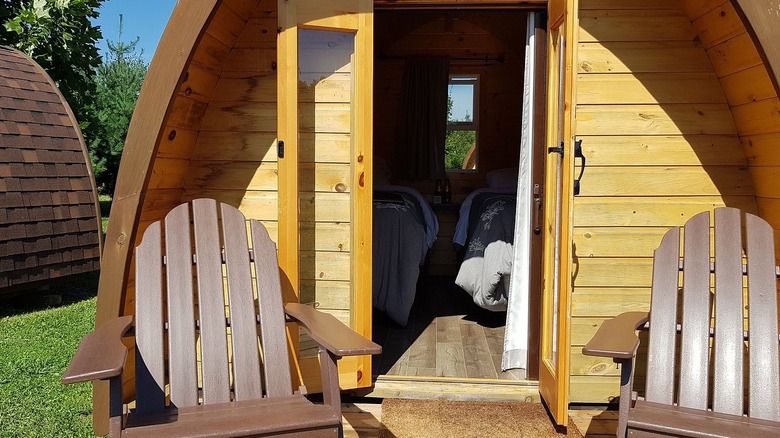
About 60% of prospective developers plan to build cabins or tiny homes, nearly double the next category. Heilala said soft-sided units still command competitive and sometimes premium rates. Hybrid models that offer “the experience of a tent” with a cabin’s four-season operational ease are gaining traction.
Location still matters. 70% of standalone glamping properties sit within 50 miles of public land. In one surprising finding, proximity to a major airport was the only location factor with a negative effect on performance, possibly because guests see it as “not being remote enough,” Bahr said.
Brands and independents
The top 10 brands account for 15% of U.S. glamping properties but 40% of units. Brand properties average about 40 units each, compared with about nine for independents. Panelists said the category has room for both, and that the brands’ marketing spend helps legitimize glamping overall.
Confidence, with caveats
90% of survey respondents said they are confident about the industry’s next three years. Far fewer said they were confident they could withstand a major disruption, such as extreme weather, an economic downturn or a drop in bookings.
Heilala urged developers to plan for the worst case and to expect tougher scrutiny from lenders on team experience, cash reserves and realistic pro formas.
“They’re looking for the opposite of ‘if you build it, they will come,’” she said.
from:woodallscm.com
published 2026-09-30 17:15:47