There are two kinds of people when it comes to camping. The first owns a tent, knows how to put it up without consulting YouTube and considers sleeping on the ground part of the fun. The second likes the idea of waking up in the mountains, eating breakfast in the open air and falling asleep under a sky full of stars, but would prefer not to discover what their back thinks about a sleeping bag.
Glamping was, more or less, made for the second group.
A portmanteau of ‘glamorous’ and ‘camping’, glamping takes the basic premise of spending time outdoors and changes the accommodation around it. Instead of a nylon tent and a camping mat, you might find a king-size bed, proper linen, a private bathroom and a deck looking straight into the landscape. Depending on where you stay, there could also be a fireplace, a soaking tub or dinner waiting outside.
But reducing glamping to camping with expensive furniture misses the point. Its appeal lies in the way it brings together two things that were once treated as opposites: being close to nature and wanting a certain level of comfort.
Camping, But Make It Comfortable
The most interesting thing about glamping is that the tent is no longer really a tent.
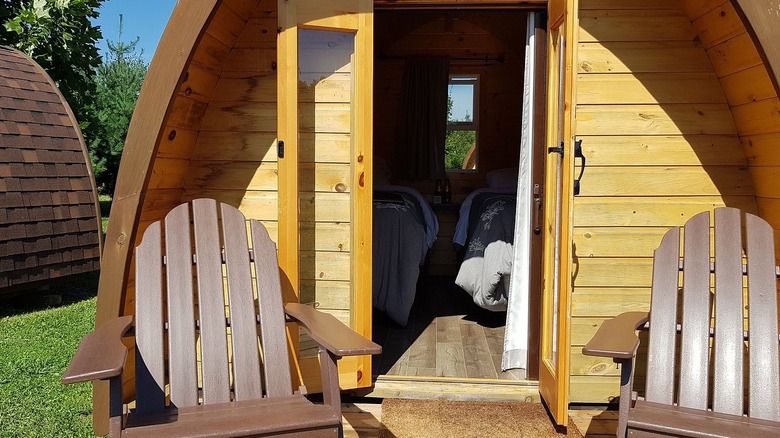
Across different destinations, glamping accommodation can take the form of safari tents, domes, cabins, treehouses, yurts, Airstream-style trailers and even glass structures designed specifically for uninterrupted views. Some feel deliberately rustic; others look closer to a boutique hotel room that happens to be sitting in a forest.
The details vary, but the philosophy stays fairly consistent. You are still outside, only the indoors have been made considerably more appealing.
That distinction matters because glamping isn’t really about recreating a hotel in the wilderness. The landscape remains central. Your bed might face a mountain, your shower might open onto a forest and your morning coffee might come with a view that would be difficult to replicate from a city balcony.
The luxury is in the access.
The Tent Is No Longer The Hard Part
Traditional camping asks you to be fairly self-sufficient. You pitch the tent, organise your food, manage the fire and figure out where everything goes. Glamping takes some of that logistical work out of the equation.
You arrive, unpack and start exploring. That doesn’t mean every glamping experience is polished to the point of feeling anonymous. In fact, the best ones tend to borrow from their surroundings. Interiors might use local materials, handmade furniture or regional textiles, while the architecture is designed around the landscape rather than placed against it.
There is something appealing about that middle ground. You can spend the afternoon hiking through a forest and return to a hot shower. You can watch the sunset from a campfire and then sleep on an actual mattress. You can be properly offline for a few hours without having to make your own dinner from a tin.
It is still camping. Just with fewer chores.
What You Actually Do When You Go Glamping
One misconception about glamping is that the accommodation becomes the entire experience. In reality, most stays are built around getting you out of it. The activities depend entirely on the destination. In a forest, that could mean guided walks, cycling or wildlife spotting. By a river, kayaking and fishing might take over the itinerary. In a desert, there could be horseback riding, dune excursions or stargazing. In the mountains, hiking, climbing and long walks tend to make more sense.
And then there is the campfire, perhaps the one part of traditional camping that glamping has no interest in replacing.
There is something about sitting around a fire at the end of the day that remains difficult to improve upon. The difference is that you might now be doing it from a proper chair, with dinner being prepared nearby and a warm bed waiting when the temperature drops.
Food, Fire And The Little Things
There is also a social side to glamping that traditional camping doesn’t always emphasise.
Meals become part of the ritual. Breakfast can stretch into the morning because there is nowhere else to be. Dinner might be served outdoors, cooked over a fire or built around ingredients sourced from the surrounding region. A campfire becomes less about survival and more about lingering.
The experience is often slower by design. You might read a book in the afternoon, take a long walk before sunset, have dinner outside and spend the evening looking up rather than scrolling down. None of this is particularly revolutionary, but placing it somewhere removed from the usual rhythm of daily life can make it feel different.
Who Is Glamping Really For?
You don’t need to be an outdoors person to enjoy glamping. That might actually be its biggest draw.
It works for couples who want a weekend away without a rigid itinerary, families looking for something beyond a conventional resort and travellers who want to experience a particular landscape without committing to full-blown camping. It can be social or solitary, active or slow, depending on how you approach it.
The common thread is curiosity about the outdoors, without the requirement to become an expert in it.
The Point Is Still To Get Outside
For all the design, good food and comfortable beds that have become part of glamping, the most convincing version of it remains fairly simple: you are there to spend time somewhere else.
The stars are still the stars. A forest still sounds different at night. A mountain looks better when you aren’t checking the time. The campfire still works because humans have been gathering around fires long before anyone thought to put a luxury mattress inside a canvas tent.
Glamping just removes some of the barriers between wanting that experience and actually having it.
So perhaps it isn’t really about making camping glamorous. It is about making the outdoors easier to enter, especially for people who were never going to sleep on the ground voluntarily. And if that means waking up under the stars, followed by a proper shower and a very good breakfast, we’re not sure the wilderness will mind.
from:elle.in
published 2026-08-23 12:00:37